
Blog - May 12 2026
Contrarian View - AI will impact productivity and enterprise software revenues before people
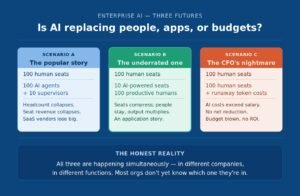
The dominant narrative about enterprise AI first replacing people should be challenged.
BACKGROUND
Everyone's debating whether AI will replace workers. While this is obvious in many sectors such as ride sharing, it is not obvious for enterprise skilled roles such as sales. (Development, despite the headlines, is also not obvious.) The intriguing question, and the one CFOs likely will soon be asking, is whether AI is replacing skilled jobs at a cost that actually makes sense in the enterprise.
Start with where this analysis usually lands: the "100 seats going to 10" story. If 10 AI agents can do the work of 100 sales reps, you don't need 100 Salesforce seats anymore. That's a clean narrative, and it rattled software stocks enough to wipe $300 billion in market cap in a single February trading session — the "SaaS-Pocalypse." [1]
But that framing assumes AI is cheaper than the humans it's replacing. Increasingly, it isn't.
"For my team, the cost of compute is far beyond the costs of the employees." — Bryan Catanzaro, VP of Applied Deep Learning, Nvidia [2]
Uber's CTO already burned through the company's entire 2026 AI budget on token costs before the year was half over. One startup CEO publicly boasted about a $113,000 monthly Anthropic bill for a four-person team. That’s roughly $28,000 per person per month, almost certainly exceeding individual salaries. The term "tokenmaxxing" has entered the engineering lexicon, with some power users running up personal token bills north of $150,000 a month. [3]
SCENARIOS
The facts above reframe the enterprise AI picture. There are at least three plausible futures here:
Scenario A: The Popular Story
100 human seats → 100 AI agents + 10 human supervisors. Headcount collapses. AI does the work. Software vendors lose seat revenue.
Scenario B: The Underrated One
100 human seats → 10 AI-agent seats. Humans don't disappear. Instead, they become dramatically more productive, each doing the work of 10. Enterprise seat count falls; output doesn't.
Scenario C: The One CFOs Are Living
100 human seats → 100 human seats + runaway AI token costs that exceed the original headcount budget. No net reduction. Just a new line item nobody planned for.
THE HONEST ANSWER
All three are happening simultaneously, in different companies, in different functions — and most organizations don't yet know which scenario they're in.
Scenario B is the most underappreciated. A company that goes from 100 seats to 10 that are AI-powered isn't replacing its people. Instead, it's radically increasing productivity for all of the staff. The seat compression may be real, but it's an application story, not a jobs story. The SaaS vendor can lose 90 seats of revenue. But, the humans are still there, just operating at a different scale.
Scenario C is what's actually dominating the headlines right now. Gartner projects worldwide IT spending will hit $6.31 trillion in 2026. This is up 13.5% year-over-year, driven overwhelmingly by AI infrastructure and compute costs. [4] Big Tech has announced $740 billion in capital expenditures, a 69% jump from 2025. [5] And despite all of it, the Yale Budget Lab finds no widespread data yet to support the idea that AI is actually displacing jobs at scale. [5]
The uncomfortable arithmetic: AI will have to prove itself both cheaper and more predictable before the replacement math works. As one analyst put it, the question isn't just "can AI do this job", it's "can AI do this job at a cost that doesn't exceed the salary it's supposed to eliminate." [6] Right now, for many enterprises, the answer is no.
The real disruption in enterprise AI isn't a wave of layoffs or even a SaaS pricing crisis. It's a deeply unglamorous budgeting problem. Companies bought into the "AI is free labor" story. Token bills are writing the rebuttal in real time.
WRAP UP: DRILLDOWN ON SCENARIO B
In contrast, an example of Scenario B productivity efficiency is SAP’s collaboration with DataRobot. Before, planning was a slow, deliberate process that would take weeks to months to adapt to change. By embedding agentic AI, planning moves to near real-time.“The true value of SAP’s approach lies in its ability to transform planning into a continuous, real-time decisioning capability through its Agentic Proactive Steering framework. By embedding intelligence directly into planning workflows, SAP enables organizations to monitor performance, evaluate scenarios, and act on insights in minutes rather than weeks.”[7]
The winners will be organizations that land in Scenario B: fewer seats, dramatically more capable humans, and a cost model they can plan and forecast. That's not a story about AI replacing people. It's a story about AI multiplying productivity for people at a cost that enterprises can afford.
[1] Forbes, Axios / Benton Institute, $300 Billion Evaporated. The SaaS -Pocalypse Has Begun, Feb. 2026: https://www.forbes.com/sites/donmuir/2026/02/04/300-billion-evaporated-the-saaspocalypse-has-begun/
[2] Byteiota, Uber AI Budget Blown: Claude Code Costs Hit $3.4B in 2026, Apr. 2026: https://byteiota.com/uber-ai-budget-blown-claude-code-costs-hit-3-4b-in-2026
[3] Futurism / Yahoo Finance, Bosses Are Blowing More Money on AI Agents Than It'd Cost Them to Just Pay Human Workers, Apr./May 2026: https://futurism.com/artificial-intelligence/bosses-more-money-ai-agents-human-salary
[4] Inc. / Metaintro, Are Humans Actually Cheaper Than AI?, Apr. 2026: https://www.inc.com/amaya-nichole/are-humans-actually-cheaper-than-ai-why-digital-workers-are-blowing-up-2026-budgets/91337342
[5] Yale Budget Lab, Evaluating the Impact of AI on the Labor Market: Current State of Affairs, Oct. 2025:https://budgetlab.yale.edu/research/evaluating-impact-ai-labor-market-current-state-affairs
[6] Fortune, Nvidia Exec Reveals AI More Expensive Than Human Workers, Apr. 2026: fortune.comhttps://fortune.com/2026/04/28/nvidia-executive-cost-of-ai-is-greater-than-cost-of-employees/
[7] DataRobot, From Planning to Action: SAP Enterprise Planning enhanced by DataRobot, May 2026, https://www.datarobot.com/blog/from-planning-to-action-sap-enterprise-planning-enhanced-by-datarobot/